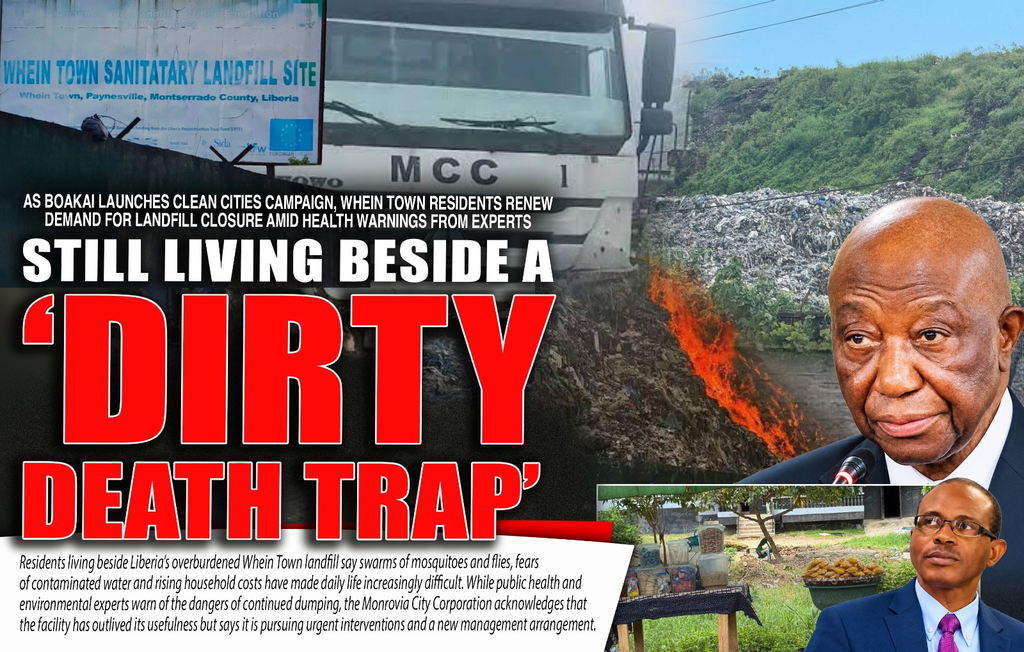
As Boakai Launches Clean Cities Campaign, Whein Town Residents Renew Demand for Landfill Closure Amid Health Warnings from Experts
What the source reports
PAYNESVILLE, Montserrado County — After sunset, when mosquitoes descend on homes in Whein Town, residents say spending time outdoors becomes almost unbearable. During the day, swarms of flies hover around food and businesses, while foul-smelling water and the presence of rodents and snakes fuel fears about what living beside a massive garbage dump may be doing to their health. By Gerald C. Koinyeneh For families in this community outside Monrovia, the struggle is not simply about living near garbage. It is about the growing cost of securing clean water, protecting children from insects and trying to maintain a livelihood in an environment they say has become increasingly difficult to endure.
The source of much of their frustration is the Whein Town Landfill, a facility established as a temporary solution to Liberia’s urban waste problem but still receiving garbage years beyond its intended lifespan. Residents say the continued dumping has left them feeling abandoned by authorities responsible for managing the waste generated by Monrovia and Paynesville. “We are being used as sacrificial lambs,” said Amos Moore, a resident who accused the government of failing to honour its commitment to close the landfill after its original five-year lifespan expired. “It is a shame that the government will unleash such suffering on a large group of its people. ” For residents such as Moore, the central question is why a facility intended to provide a temporary answer to an urgent sanitation problem has become a seemingly permanent feature of their community, while promises of relief remain unfulfilled. Their concerns have drawn renewed attention from public health and environmental experts, who warn that poorly managed landfills can expose nearby populations to serious risks,…
TDBN presents the written preview supplied through the publisher's feed. Complete reporting, continuing updates, context, and corrections remain with the original report.
Read the complete report ↗